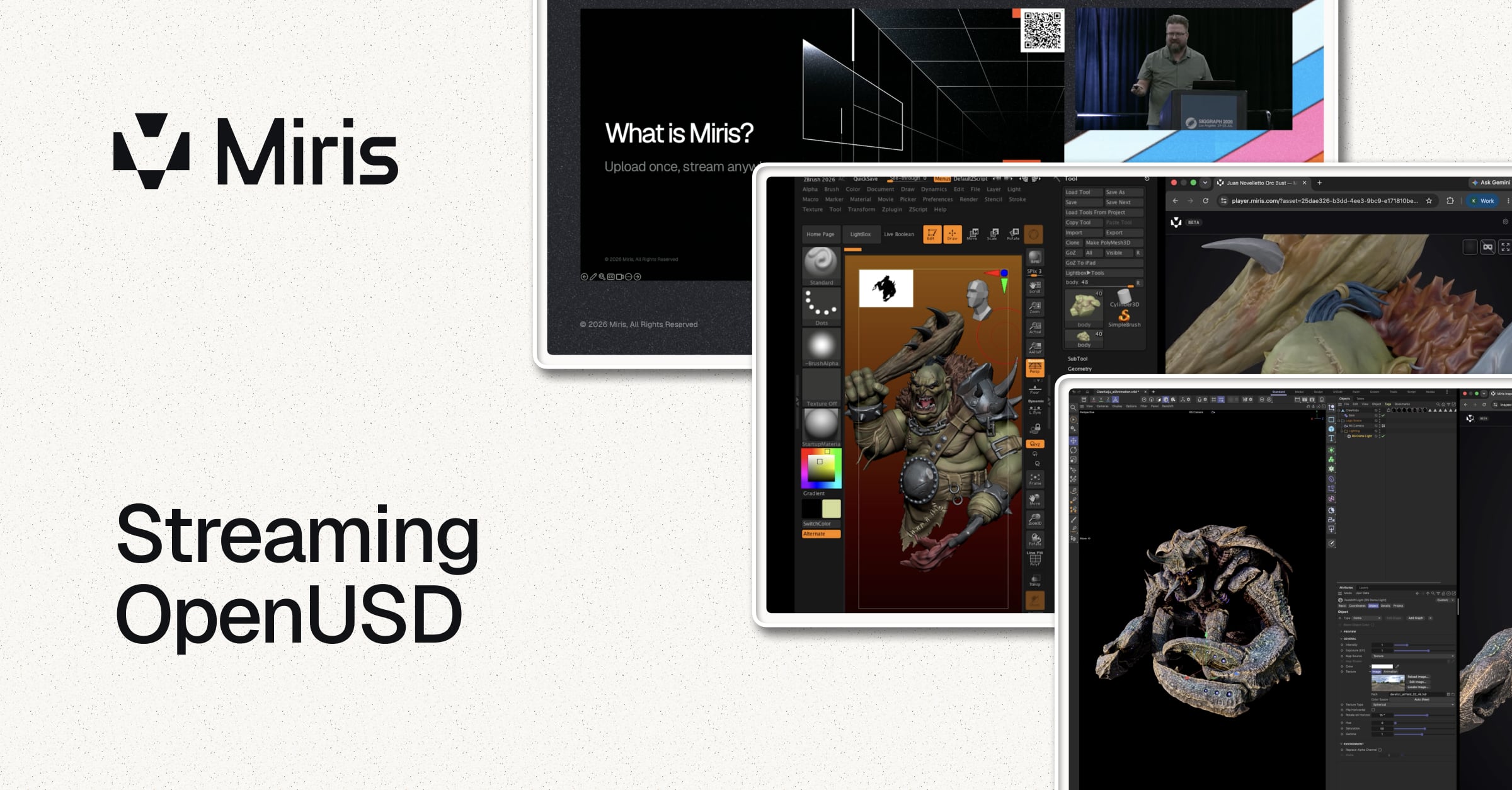







Stream 3D content without limits

AI-optimized streaming that delivers 3D content at billion-user scale.
Trusted Customers & partners
Built for developers

Stream 3D to any device

Stream high-fidelity 3D content to any device — without downloads, infrastructure headaches, or unpredictable costs.
Join the beta
Join leading companies testing 3D content streaming in production. Early access includes dedicated engineering support and priority feature requests.
Join the beta
Join leading companies testing 3D content streaming in production. Early access includes dedicated engineering support and priority feature requests.
Ship 3D today, not in months

Upload an OpenUSD asset, get a streaming endpoint, and integrate in under a week. No infrastructure to provision. Just a URL that streams high-fidelity 3D to any device.

Test against your real content

The beta isn't a sandbox, it's the production platform. Bring your own assets and see what Miris means for your specific use case before you commit.

Multi-device delivery, no extra work

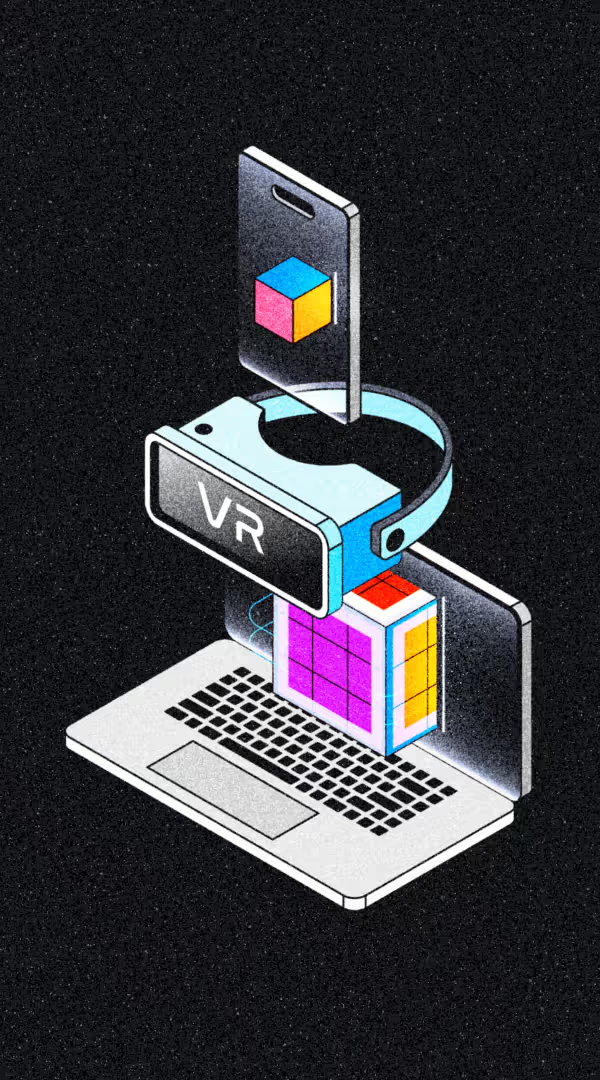
Stream to desktops, tablets, mobile, and XR headsets from a single upload. Adapts quality and resolution automatically based on device capability and network conditions.

For Developers
Platform

How it works

Stream every asset instantly while keeping your infrastructure simple and scalable.

Start with any USD object or imagery

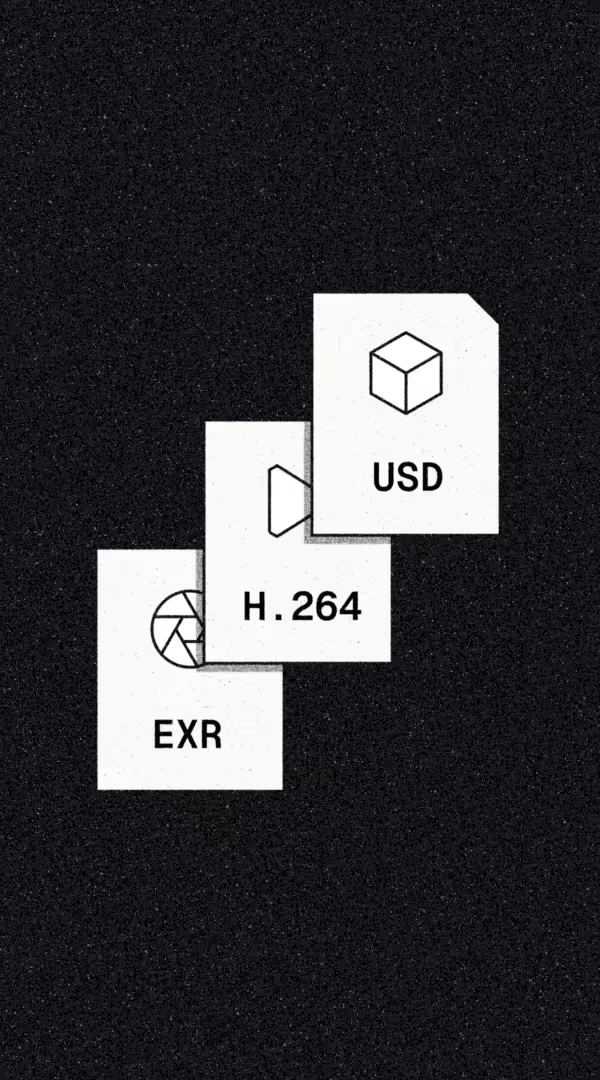
Import any 3D asset in OpenUSD format. Miris accepts models up to 10GB with textures, materials, and lighting data intact. Author in your digital content creation tool of choice, whether you’re working with CAD models, photogrammetry scans, or game assets, start with what you have.

Supports textures, materials, and lighting data.
No manual stripping or re-export required.
Up to 10GB per asset.
Large architectural models and high-poly scans accepted.
Export guides for Blender, Maya, Houdini, and more.
Step-by-step USD export documentation.

Build the foundational asset

Miris converts your source file into a streaming-optimized format. Multi-resolution LODs are generated automatically. Geometry is compressed. Textures are optimized. Visual fidelity is preserved from the original. This is the foundation that makes adaptive 
delivery possible.

Automatic LOD generation.
Multiple levels of detail from a single source file.
Lossless visual fidelity.
Source materials, lighting, and textures preserved.
Export guides for Blender, Maya, Houdini, and more.
Step-by-step USD export documentation.

Optimize for every device and network

Miris analyzes each asset’s geometry complexity, texture resolution, and material composition to determine optimal compression and encoding strategies. The result: maximum visual quality delivered within your viewers’ bandwidth and device constraints. Quality adapts per viewport, per device, per network condition.

Per-asset analysis.
Compression strategies based on actual geometry and texture complexity.
Bandwidth-aware encoding.
Optimized for fiber, cellular, and constrained networks.
Device-aware quality tiers.
Desktop GPU, mobile, and XR headsets each get appropriate fidelity.

Your asset is stream-ready

Your processed asset is now optimized for progressive delivery. Content is visible in seconds. Full detail loads as users explore. Quality transitions are automatic, adapting to viewport distance, device capability, and network conditions in real time.

First frame in milliseconds.
Visible before full detail arrives.
Progressive loading.
Detail increases as users zoom and rotate.
Resolution-independent.
Same source, optimized output per device.

Data where you need it

Miris routes your content through a global CDN. Assets are cached at edge nodes close to your users. Predictive loading ensures sub-second response times regardless of asset complexity or user location. No origin server bottleneck. Performance is predictable from day one.

Global CDN delivery.
Nearest edge node serves every request.
Predictive caching.
Sub-second response times worldwide.
No per-session compute.
Costs scale with storage, not concurrency.

Integrate into your workflow

Connect Miris to the tools you already use. Drop a component into React, Vue, or vanilla JS — our Web SDK integrates directly with three.js as the runtime environment. No workflow changes. No re-architecture. Your tools, your pipeline, our delivery layer.

Web SDK.
JavaScript for web with TypeScript types. Integrates with three.js and any WebGL-compatible renderer.
Zero lock-in.
Miris sits alongside your current stack. Standard components, standard patterns. Remove it and your app still builds.
More platforms (comings soon).
Native SDKs for mobile and game engines are on the roadmap. Join the beta to shape what's next.

Build once, stream anywhere

Embed in any web app with a React, Vue, or vanilla JS component. Your users don't download anything — they just open a link and see your model instantly, whether they're on a laptop, phone, or WebXR headset. One asset, one endpoint, every browser.

Web SDK.
React, Vue, vanilla JS. ~18KB gzipped. TypeScript types included.
Cross-device.
Runs in any modern browser — desktop, mobile, or headset. No native app required.

Start with any USD object or imagery

Import any 3D asset in OpenUSD format. Miris accepts models up to 10GB with textures, materials, and lighting data intact. Author in your digital content creation tool of choice, whether you’re working with CAD models, photogrammetry scans, or game assets, start with what you have.

Supports textures, materials, and lighting data.
No manual stripping or re-export required.
Up to 10GB per asset.
Large architectural models and high-poly scans accepted.
Export guides for Blender, Maya, Houdini, and more.
Step-by-step USD export documentation.

Build the foundational asset

Miris converts your source file into a streaming-optimized format. Multi-resolution LODs are generated automatically. Geometry is compressed. Textures are optimized. Visual fidelity is preserved from the original. This is the foundation that makes adaptive 
delivery possible.

Automatic LOD generation.
Multiple levels of detail from a single source file.
Lossless visual fidelity.
Source materials, lighting, and textures preserved.
Export guides for Blender, Maya, Houdini, and more.
Step-by-step USD export documentation.

Optimize for every device and network

Miris analyzes each asset’s geometry complexity, texture resolution, and material composition to determine optimal compression and encoding strategies. The result: maximum visual quality delivered within your viewers’ bandwidth and device constraints. Quality adapts per viewport, per device, per network condition.

Per-asset analysis.
Compression strategies based on actual geometry and texture complexity.
Bandwidth-aware encoding.
Optimized for fiber, cellular, and constrained networks.
Device-aware quality tiers.
Desktop GPU, mobile, and XR headsets each get appropriate fidelity.

Your asset is stream-ready

Your processed asset is now optimized for progressive delivery. Content is visible in seconds. Full detail loads as users explore. Quality transitions are automatic, adapting to viewport distance, device capability, and network conditions in real time.

First frame in under 2 seconds.
Visible before full detail arrives.
Progressive loading.
Detail increases as users zoom and rotate.
Resolution-independent.
Same source, optimized output per device.

Data where you need it

Miris routes your content through a global CDN. Assets are cached at edge nodes close to your users. Predictive loading ensures sub-second response times regardless of asset complexity or user location. No origin server bottleneck. Performance is predictable from day one.

Global CDN delivery.
Nearest edge node serves every request.
Predictive caching.
Sub-second response times worldwide.
No per-session compute.
Costs scale with storage, not concurrency.

Integrate into your workflow

Connect Miris to the tools you already use. Drop a component into React, Vue, or vanilla JS — our Web SDK integrates directly with three.js as the runtime environment. No workflow changes. No re-architecture. Your tools, your pipeline, our delivery layer.

Web SDK.
JavaScript for web with TypeScript types. Integrates with three.js and any WebGL-compatible renderer.
Zero lock-in.
Miris sits alongside your current stack. Standard components, standard patterns. Remove it and your app still builds.
More platforms (comings soon).
Native SDKs for mobile and game engines are on the roadmap. Join the beta to shape what's next.

Build once, stream anywhere

Embed in any web app with a React, Vue, or vanilla JS component. Your users don't download anything — they just open a link and see your model instantly, whether they're on a laptop, phone, or WebXR headset. One asset, one endpoint, every browser.

Web SDK.
React, Vue, vanilla JS. ~18KB gzipped. TypeScript types included.
Cross-device.
Runs in any modern browser — desktop, mobile, or headset. No native app required.